Manufacturer information, sources checked 19 October 2026. Source-based reporting; no hands-on testing. This is an upcoming-product profile of a preorder launch announced in October 2025.
1X’s NEO is a humanoid robot aimed at the jobs that accumulate around a home: fetching an item, putting things away and helping with household chores. The company opened preorders on 28 October 2025 and announced initial U.S. deliveries for 2026. Its ordering page still carries that delivery year. Customer shipments have not been independently verified for this article, so NEO remains an upcoming product in this coverage. Launch announcement;
Related discoveries
Published products with matching topics or technologies.
The appeal is easy to understand. Instead of adding another device for one narrowly defined household job, NEO proposes a moving assistant that can interact with objects and people. The important qualification comes with Early Access: 1X describes basic autonomy, alongside scheduled remote help for unfamiliar tasks. That makes the launch an invitation to participate in an early home-robot rollout, with usefulness depending on the capabilities actually supplied.
For readers following household robotics, NEO offers something concrete to examine: a named consumer product, an ordering route and a stated service model. It also creates a more useful question than whether humanoid robots look convincing in a video. Which part of a domestic job can the delivered robot complete independently, and which part still depends on a person? The distinction runs through the hardware, AI and pricing information below.
What 1X wants NEO to do at home
1X’s launch material names folding laundry, organizing shelves and tidying spaces among NEO’s intended chores. It describes fetching objects, opening doors for guests and switching off lights as basic functions planned for early owners. The announcement also presents conversational uses, including grocery lists and reminders. These are manufacturer descriptions of the intended experience, rather than results from a NewDrops household test. 1X’s launch description.
There are two kinds of household value in that list. Some jobs involve physical action, such as transporting an object or putting it away. Others involve helping someone keep track of information. A reader who wants help carrying things should therefore focus on the robot’s supported physical tasks; someone interested in conversational assistance has a different set of expectations to assess. A successful conversation does not establish successful object handling.
The task boundary matters just as much as the task name. Folding a prepared item and managing a complete laundry routine are different promises. Likewise, fetching something from an identified location is different from searching an entire house. The launch examples should be read at the scope actually documented. This profile does not extend them into a promise that NEO can independently take over every step of cleaning, laundry or household organization.
Image: Courtesy of 1X. Editorial news use permitted by https://www.1x.tech/press for articles about 1X products; rights remain with 1X. Required credit: Courtesy of 1X.
Three operating modes change what “help” means
1X describes NEO’s Early Access autonomy as foundational. For unfamiliar or complex chores, its Expert Mode lets an owner schedule remote supervision by a 1X expert. The product description separately offers remote piloting through a mobile app and VR device. Autonomous action, expert assistance and owner control are therefore different ways of getting a task done. NEO utility and controls.
That distinction is useful when watching a demonstration. The visible movement may look similar whether the robot selects the action itself or receives human guidance. To understand the result, a viewer needs the operating mode as well as the task. A demonstration can show that the hardware performs a movement without establishing that the complete job runs independently. This article makes no estimate of how frequently expert intervention will be needed in a customer’s home.
Assisted operation may still suit an early adopter who accepts scheduled involvement. It changes the experience, however: the household is evaluating both a machine and a supporting service. Expert availability, session arrangements and the handling of an unsuccessful attempt become relevant alongside the robot’s movements. The public descriptions checked do not establish a service response time or a guaranteed assisted completion rate, and neither is assumed here.
The AI has separate roles in movement and conversation
The product page identifies Redwood as 1X’s model for learning and performing household tasks. It also describes a language model for conversation, with audio and visual context and memory features. AI is central to NEO’s stated purpose, rather than a label applied only to wireless connectivity. The useful distinction is between understanding an interaction and carrying out a physical action in the home. Manufacturer’s AI description.
For example, remembering information from a conversation could support continuity when someone speaks to the robot again. That is a different benefit from recognizing an object and manipulating it correctly. Both may contribute to a household assistant, but evidence for one does not establish the other. NEO’s combination is interesting because it brings these roles into a single product; its reliability across those roles still needs evidence from the supplied consumer system.
1X’s April 2026 factory article says NEO Cortex uses NVIDIA Jetson Thor for on-robot inference, including perception, reasoning and decision-making. This establishes a stated role for local processing. It does not establish that every feature operates offline or that all household data stays on the robot. A complete function-by-function account of local processing, cloud services and account requirements was not established by the sources checked. 1X’s compute description.
How 1X evaluates new robot behavior
In a research article dated 16 June 2025, 1X describes a world model that predicts possible outcomes of robot actions. The development approach helps researchers compare behaviors before relying solely on physical trials. The article also documents limitations involving unfamiliar objects and explains how task-specific interaction data can improve its predictions. This is historical research context, not a performance specification for a customer’s NEO. 1X World Model.
The practical value of this research explanation is that it makes the learning claim less abstract. Predicting an action’s consequences is one development tool; delivering a dependable household skill is the consumer outcome. Those stages should remain separate. A promising evaluation method can support further development without proving that a particular chore is ready for independent use in every home.
For the same reason, software improvement should be treated as an additional possibility rather than the sole reason to order. A household can assess documented current functions against its needs. Future capabilities become meaningful when their availability and conditions are specified. This avoids attaching an imagined schedule to a broad statement that the robot will improve over time, while still recognizing why continued development is part of an Early Access product.
Battery and connectivity set practical boundaries
1X lists a four-hour runtime and Wi-Fi, Bluetooth and 5G connectivity for NEO. The runtime is a manufacturer specification; the page does not establish a four-hour result for a particular mix of household chores. A connected robot's quoted endurance should therefore be kept separate from a promise about how many jobs it will finish. The listed radios also do not establish an included cellular plan or universal network support. Hardware specifications.
The hand specification needs careful reading
On 9 July 2026, 1X announced a hand assembly with 25 degrees of freedom: 22 in the fingers and palm, plus three at the wrist. Degrees of freedom describe independent movement dimensions. The company says these hands will ship on every NEO. Its product page lists 22 for each hand, without explicitly reconciling that listing with the newer announcement. The assigned order configuration should therefore be confirmed rather than inferred. Hand announcement; product specifications.
The July article also describes tactile sensing and force feedback. In the company’s account, contact information contributes to handling an object, rather than relying only on what the robot sees. That gives household readers a useful way to understand the engineering focus: a hand has to interact with an object, as well as reach it. These remain manufacturer descriptions, not independently measured handling results in this profile.
A higher movement count alone cannot tell a buyer whether a whole chore will succeed. The relevant result involves identifying the object, reaching it, making contact, moving it and finishing the requested job. The hand announcement is consequently evidence about the proposed hardware, while repeated task completion would be evidence about the household experience. Treating those as separate questions avoids turning component detail into an unsupported promise of general capability.
Image: Courtesy of 1X. Editorial news use permitted by https://www.1x.tech/press for articles about 1X products; rights remain with 1X. Required credit: Courtesy of 1X.
Price, subscription and delivery describe different commitments
The order page lists $20,000 for Early Access ownership, with a three-year warranty, premium support and priority delivery. Standard is advertised at $499 a month, with standard delivery and a starter productivity package. It also lists a fully refundable $200 deposit. These are U.S.-dollar advertised offers checked on 19 October 2026; the deposit is not the total cost of the robot. Current offer.
The original announcement says the subscription option ships later than Early Access ownership, and sets international expansion to begin in 2027. Those plans do not establish a delivery date for an individual order or availability at every overseas address. Launch pricing and rollout.
Ownership and subscription are different arrangements, so a simple division of the headline prices would leave out important terms. The comparison needs the included functions, support, cancellation provisions and repair arrangements. Those details affect what the household is committing to over time. No total running-cost estimate, rent-to-own interpretation or claim about included expert-session allowances is offered here because the evidence checked does not establish them.
Factory progress supports the rollout story, not a shipment claim
In its 30 April 2026 manufacturing update, 1X described production in Hayward, California, and said early units were being prioritized for staff home testing. The same update reaffirmed plans for first customer deliveries in 2026. Production progress and internal testing are relevant milestones, but neither independently confirms delivery to an external customer. Factory update.
Keeping these milestones separate makes the launch easier to follow. A preorder opens a route to a future product; production creates units; a customer delivery completes a different step. That distinction is especially useful here because the original announcement is from 2025 while the advertised delivery year is 2026. This is a profile of that continuing rollout proposition, rather than a claim that NEO was newly announced this month.
Remote assistance makes data handling part of the product
The privacy policy linked from 1X’s site, dated 27 October 2025, discusses website use and other interactions, including account information, service providers and retention criteria. It does not supply a complete robot-specific explanation of every camera, audio and remote-session data flow. It should therefore be read alongside any applicable customer agreement, rather than as proof that all operating data stays private or local. 1X privacy policy.
The unresolved issues are specific: authorization for remote access, what an expert can see or hear, session recording, retention and use of household data for training. This reporting does not establish the available controls for each. That matters to suitability because someone comfortable with assistance in a shared living room may have a different preference for other spaces. No blanket privacy assurance follows from the presence of on-board computing.
The next useful evidence is an ordinary task, fully shown
A meaningful assessment of NEO would follow a complete household task from its starting state to its result. It would identify the software version, operating mode, preparation, elapsed time and every intervention. Repeating the task would help separate an isolated success from a dependable routine. That is a proposed assessment method, not testing carried out for this article.
For now, NEO gives readers a defined home-humanoid offer to investigate, with a clear distinction between basic autonomy and human assistance. Its strongest relevance is to people interested in the early development of household robotics who can assess the documented offer on those terms. Readers considering a reservation can use 1X’s current ordering information to confirm the supported tasks, service conditions and delivery arrangements for their market before committing.
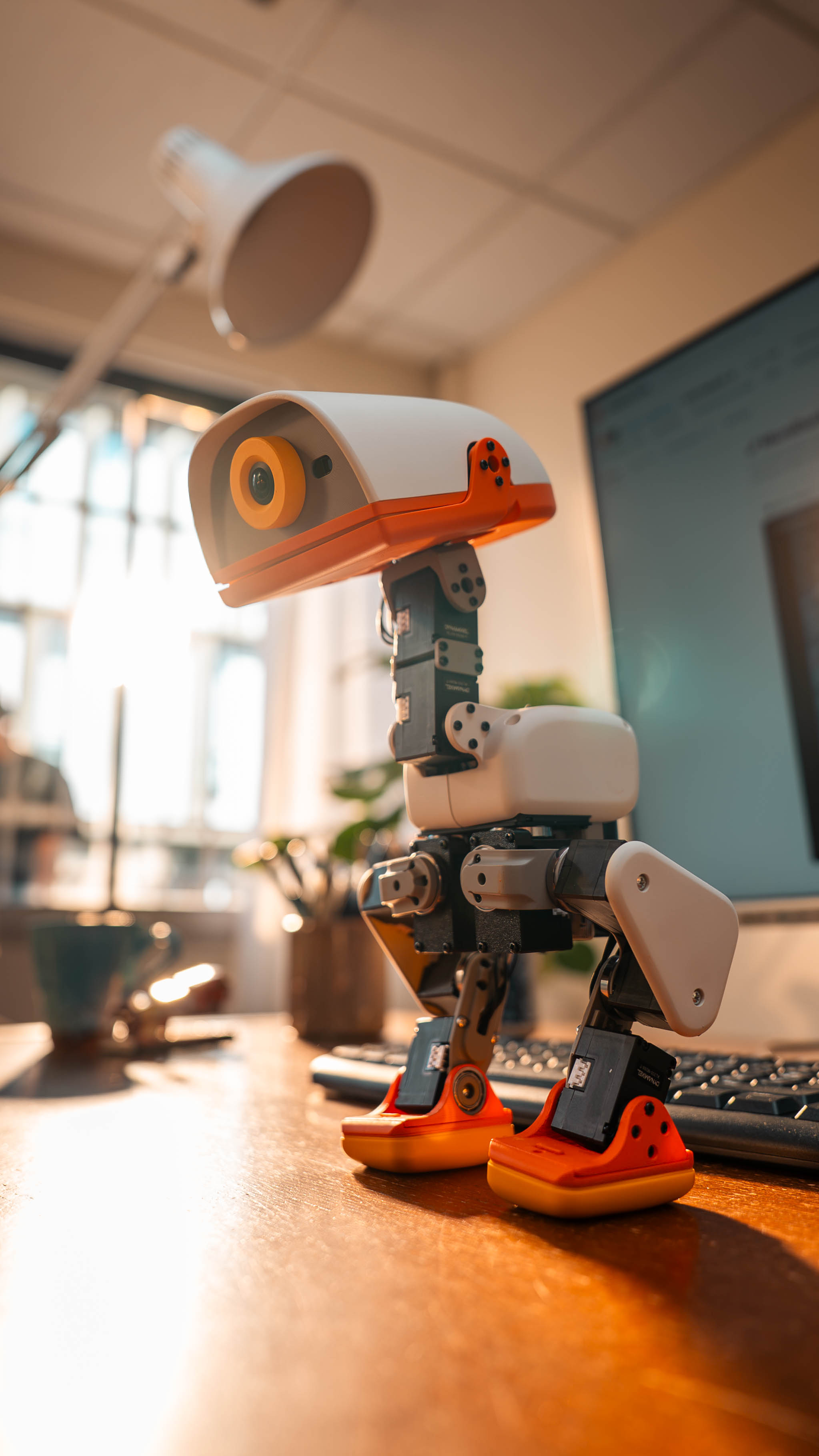
A 25 cm programmable biped robot with learned movement, a grasping beak and open-source software for physical AI experiments. Available for pre-order, with first deliveries targeted before Christmas 2026.