FR-NIA: Figurobot's expressive AI companion robot — NewDrops.Tech
Product profile / NEWDROPS.TECH
FR-NIA puts a moving face on AI companionship
Figurobot's tabletop companion uses a moving silicone face and voice interaction. We explain its expressive design, cloud dependencies and crowdfunding stage.
By Latest TechnologyPublished 11 min read
Source-based reporting · No NewDrops.Tech hands-on testing
Image: Figurobot · Figurobot-supplied launch press asset distributed via GlobeNewswire on 19 October 2026 for news coverage of FR-NIA. Editorial illustration only, unchanged, credited to Figurobot. Distribution context: https://www.globenewswire.com/Home/Send-Press-Release/Multimedia . No standalone commercial license asserted. Image source ↗
In this article
FR-NIA is a small companion robot built around an unusually physical idea: a conversation can have a face that moves, rather than an animated expression on a display. Figurobot is presenting it through a Kickstarter campaign as an expressive robot for people curious about having an AI character nearby. Its appeal is the interaction itself: looking toward someone, changing expression and responding through voice. This is emerging consumer robotics, with production and delivery still ahead, rather than a finished product we have tested. View the FR-NIA campaign.
That distinction helps frame the most useful question about Nia. Is a physical face enough to make an AI companion worth a place on your desk? The answer depends less on an impressive demonstration than on what you want from the relationship: an expressive character, a customizable robotics project, or a dependable assistant. Those are different expectations. Understanding which one you bring to Nia makes the campaign much easier to assess.
A robot focused on expression
Figurobot lists FR-NIA at 28 cm, or 11 inches, tall. The design has no arms or legs: its movement is concentrated in the face and neck. The published specifications describe a liquid-silicone face, a camera, microphones and speakers. This is a tabletop character, rather than a mobile household robot.
Related discoveries
Published products with matching topics or technologies.
The format gives it a clear identity. A person interested in expressive faces may find this more compelling than a general-purpose assistant whose main interface is a speaker. Conversely, someone looking for a robot to carry things, follow them between rooms or complete physical chores should start with a different category. Nia's interest lies in how it presents an interaction, not in adding a pair of hands to an AI service.
Consider a simple desk conversation. On a phone, the response occupies a screen that also contains messages, work and other distractions. A separate physical character could make that exchange feel more deliberate. That is a plausible reason to want this kind of device; it is not evidence that the conversation will be more accurate, helpful or emotionally meaningful. The software still has to earn your attention after the novelty of the face wears off.
Where you put it matters, too. A desk, shelf or bedside surface creates a different viewing distance and level of background noise. Before committing to any expressive robot, watch a demonstration at ordinary room scale. A close-up can show movement beautifully while telling you little about how noticeable that movement will be from across your own desk.
What the moving face adds
The maker describes ten degrees of freedom, divided between three for the neck and seven for the face. Its website also shows app tools for recording motions, adjusting keyframes, creating expressions and backing up work to the cloud. These are manufacturer descriptions of the proposed system. Figurobot's expression and customization overview.
Degrees of freedom describe movement options; they do not provide a score for how convincing a character will feel. For a reader watching the campaign, the useful comparison is between specific moments. Does the head turn naturally toward the speaker? Do expressions transition smoothly? Does the mouth movement fit the voice? Can you tell what the character is communicating without reading a caption? These questions connect the mechanism to its intended purpose.
It is also worth separating expression from understanding. A smile can communicate a response, but its appearance does not establish that the underlying AI interpreted a complicated question correctly. A convincing face may encourage a person to attribute more understanding to an answer than the words warrant. Treat the response as something to evaluate on its content, especially when it involves advice or information you plan to act on.
Customization may be the more lasting attraction for some readers. Designing a short movement involves decisions about timing, emphasis and character. A slow turn followed by a small expression conveys something different from an immediate reaction. If the tools make that experimentation approachable, the robot could interest people who enjoy character animation as much as people who simply want to chat. The quality of those tools will matter at least as much as the number of preset expressions.
This video is linked from Figurobot's own website. Use it to inspect the physical presentation: the transitions between expressions, the pace of head movement and the relationship between voice and face. It is a demonstration selected by the maker, so it should not stand in for independent testing or long-term ownership experience. Figurobot's video section.
A useful second viewing focuses on what the clip leaves unanswered. An edited sequence may be excellent at showing appearance while revealing little about response delays, recovery after a misunderstood request or behavior during a weak connection. Those missing pieces are reasonable questions for a campaign update. They do not make a demonstration worthless; they define what a demonstration can establish.
The conversation depends on the cloud
The campaign FAQ says Nia's AI processing takes place on cloud servers and needs an internet connection. It describes long-term cloud memory for conversations and preferences, with management and deletion controls planned. An open API is intended to support compatible outside AI models. English is the primary language; several additional languages remain in development. FR-NIA campaign FAQ.
This changes what ownership means. You would have a physical robot, but its conversational usefulness would also depend on an ongoing service. Before backing, ask what remains available when the connection drops. Can you still trigger stored expressions? Does the app retain local controls? How does the device communicate that a response is unavailable? Clear answers help distinguish a temporary network problem from a broken product.
Memory also deserves a more practical discussion than a promise of personalization. Remembering a preferred name is one thing; retaining a conversation you later wish you had never shared is another. Look for a clear explanation of what is saved, whether saving can be disabled, how individual records can be removed and what happens when the device changes owners. A reassuring phrase about privacy cannot answer those separate questions.
The published website privacy policy primarily discusses the online store and its customer data. It should not be treated as a complete technical description of how the robot handles audio, camera input or conversation history. Figurobot privacy policy. For a camera-and-microphone companion, a product-specific explanation would help readers make a better informed choice about where they are comfortable using it.
External-model compatibility is similarly a starting point for questions, not proof that every preferred AI service will work. Ask which integrations are supported, what configuration they require and whether provider charges are separate. If your interest depends on a particular model, confirm that exact combination. An API can provide flexibility, but the useful detail is the integration you can actually run.
Portability is different from independence
The manufacturer lists USB-C charging and data, Wi-Fi and Bluetooth connectivity, and battery life of up to five hours. That runtime is a maker claim, not a result from our testing. Published FR-NIA specifications.
For this sort of product, portability can mean moving a character from a work desk to another surface. It does not automatically mean a conversation continues anywhere without preparation. Think through the location where you expect to use it, including network access, charging and whether other people are nearby. A robot that feels pleasant in a quiet private room may be less suitable for a shared office where conversations can be overheard.
Battery questions should connect to a routine. If you want occasional short exchanges, a runtime figure has a different significance than if you expect an always-present character throughout the day. Ask what conditions the stated figure represents and how much expression, voice activity and standby time it includes. Until those conditions and independent results are available, avoid building a precise daily schedule around the maximum claim.
The physical format also introduces ordinary ownership considerations. A moving face will need a suitable place to stand and a sensible approach to cleaning and storage. Check the final care instructions before treating the surface like an ordinary collectible figure. If you plan to move it frequently, ask whether a case or other transport protection is included, rather than assuming a portable design means every accessory is supplied.
Customization should be judged as a workflow
The campaign calls its planned companion software the Faibo App and says releases for the App Store and Google Play are forthcoming. The camera tracks a person's face through eye and head movement; the robot itself stays in place. Campaign FAQ.
For anyone interested in making expressions, a good demonstration would show the entire workflow: create a motion, adjust it, send it to the robot and revise the result. That would answer more than a montage of finished expressions. Ask how a beginner starts, how mistakes are undone and whether your work can be exported or backed up independently. Time invested in customization becomes more valuable when you understand how to preserve it.
The naming difference between the website's Figurobot App and the FAQ's Faibo App is another reason to check the final software documentation. It may be easy for the maker to clarify, but a backer should not need to guess which application is required. Confirm supported phone versions and the actual download destination when software becomes available. A promised app release is different from an app you can inspect today.
Face tracking also needs to match your intended setup. Ask how the system behaves with multiple people, changes in lighting or someone stepping out of view. A robot turning its head toward a person is an understandable feature. Reliable behavior in your own room is a separate question, best answered through a fuller demonstration and later testing.
A campaign commitment, with delivery ahead
Figurobot says batch production will begin after the campaign, with shipping expected to start in March 2027 in batches. Shipping is charged separately, and destinations depend on campaign support. These are estimates and arrangements from the creator, rather than a confirmed delivery date for an individual backer. Campaign FAQ.
The maker's legal notice also says products remain under development and that the production design, software and other details may change. Figurobot development notice. Read that alongside the polished images and videos. The decision is whether you want to support development with its remaining uncertainties, not simply whether you like the finished appearance shown on a campaign page.
Before pledging, check the current reward description, your destination, the estimated shipping charge and what is actually included. Earlier reservation offers can remain visible on maker websites after a campaign starts. They should not substitute for the terms attached to the reward you are considering now. Save the relevant description so you can compare later updates with the original commitment.
Production updates will be particularly useful when they explain concrete progress: tooling, assembly, software readiness, testing and shipment preparation. A new character outfit can be enjoyable, but it answers a different question from whether the robot is ready to manufacture. Readers considering an early project should give more weight to evidence that reduces the uncertainties most relevant to delivery and everyday use.
Who may find Nia worth following
Nia makes the most sense to follow if you are interested in expressive robotics, enjoy customizing characters and understand that the proposed experience depends on both hardware and a cloud service. Its central attraction is specific: bringing a moving character into a conversation. You do not need to believe it will transform every part of daily life to find that interesting.
If you mainly want dependable answers, a particular language or a product with established long-term support, keep those requirements separate from your reaction to the face. Write down the features you would consider essential, then check which are documented today, which are promises and which remain unanswered. That simple distinction is more useful than a broad verdict about whether companion robots are the future.
The next worthwhile step is to watch the demonstration, read the current FAQ and inspect the latest campaign updates together. Look for continuity between the character you see, the service it needs and the delivery plan behind it. FR-NIA offers an interesting direction for personal robotics; the campaign's continuing job is to show how that direction becomes a reliable everyday product. View the campaign and its latest updates.
Images are Figurobot promotional illustrations, not independent testing photographs or confirmation of the final app interface.
Source-based reporting; no hands-on testing. Sources checked 23 October 2026.
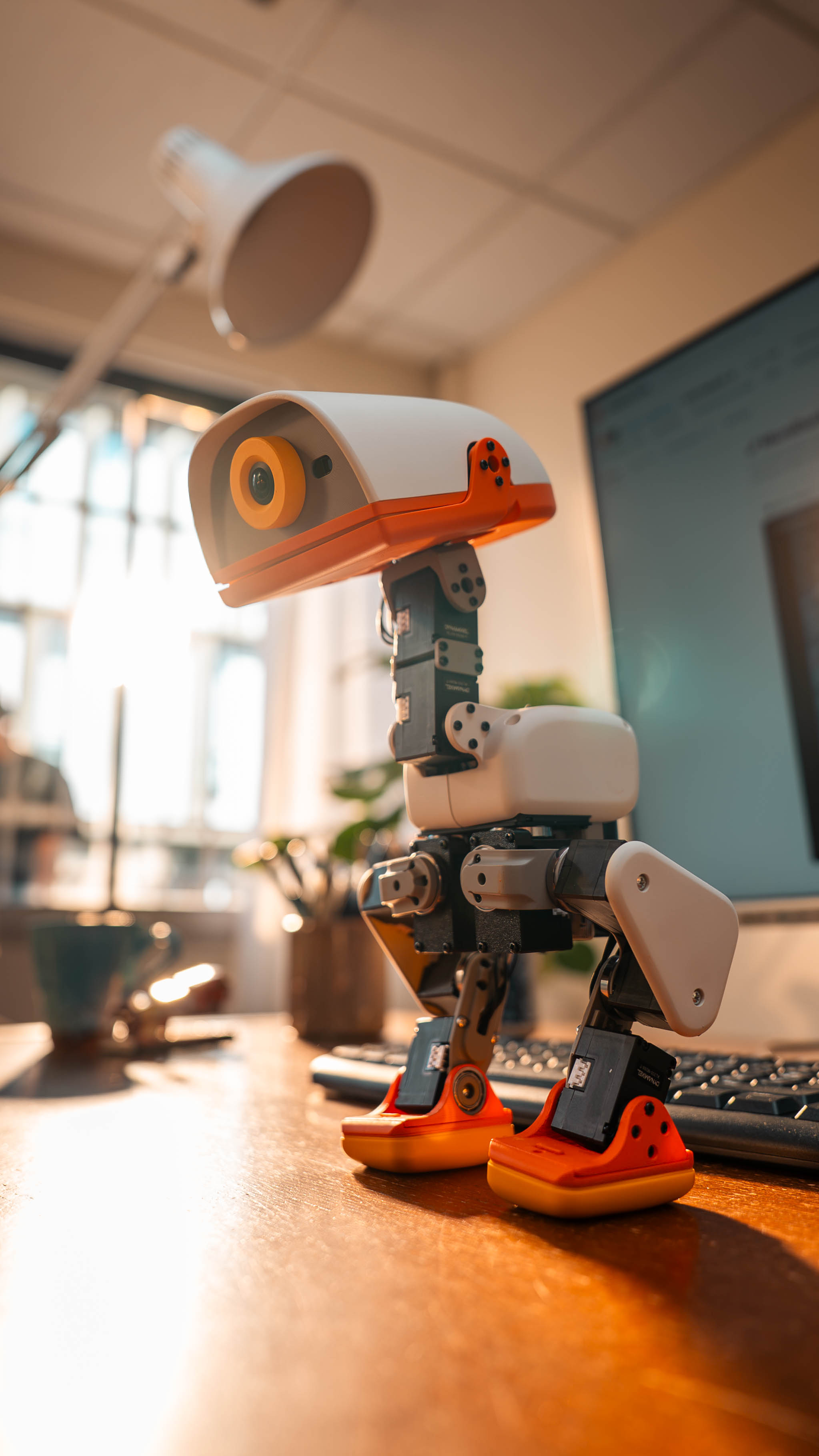
A 25 cm programmable biped robot with learned movement, a grasping beak and open-source software for physical AI experiments. Available for pre-order, with first deliveries targeted before Christmas 2026.