Microduck: The Little Robot You Can Teach to Move — NewDrops.Tech
Product profile / NEWDROPS.TECH
Microduck’s big idea: a little robot you can teach to move
Microduck turns robot learning into something you can explore. Meet Pollen Robotics’ tiny biped and see how simulated practice connects to real movement.
By Latest TechnologyPublished 11 min read
Source-based reporting · No NewDrops.Tech hands-on testing
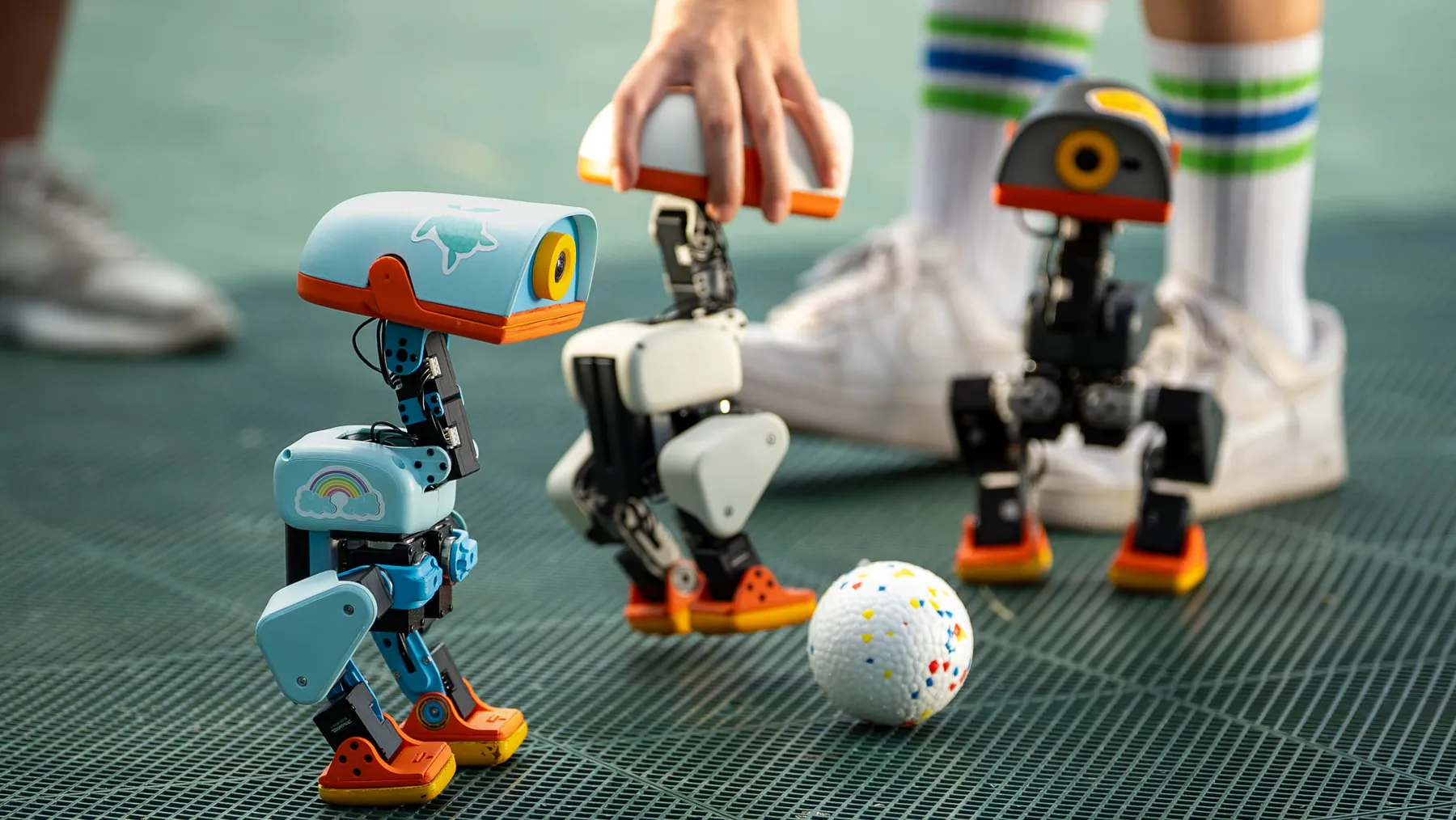
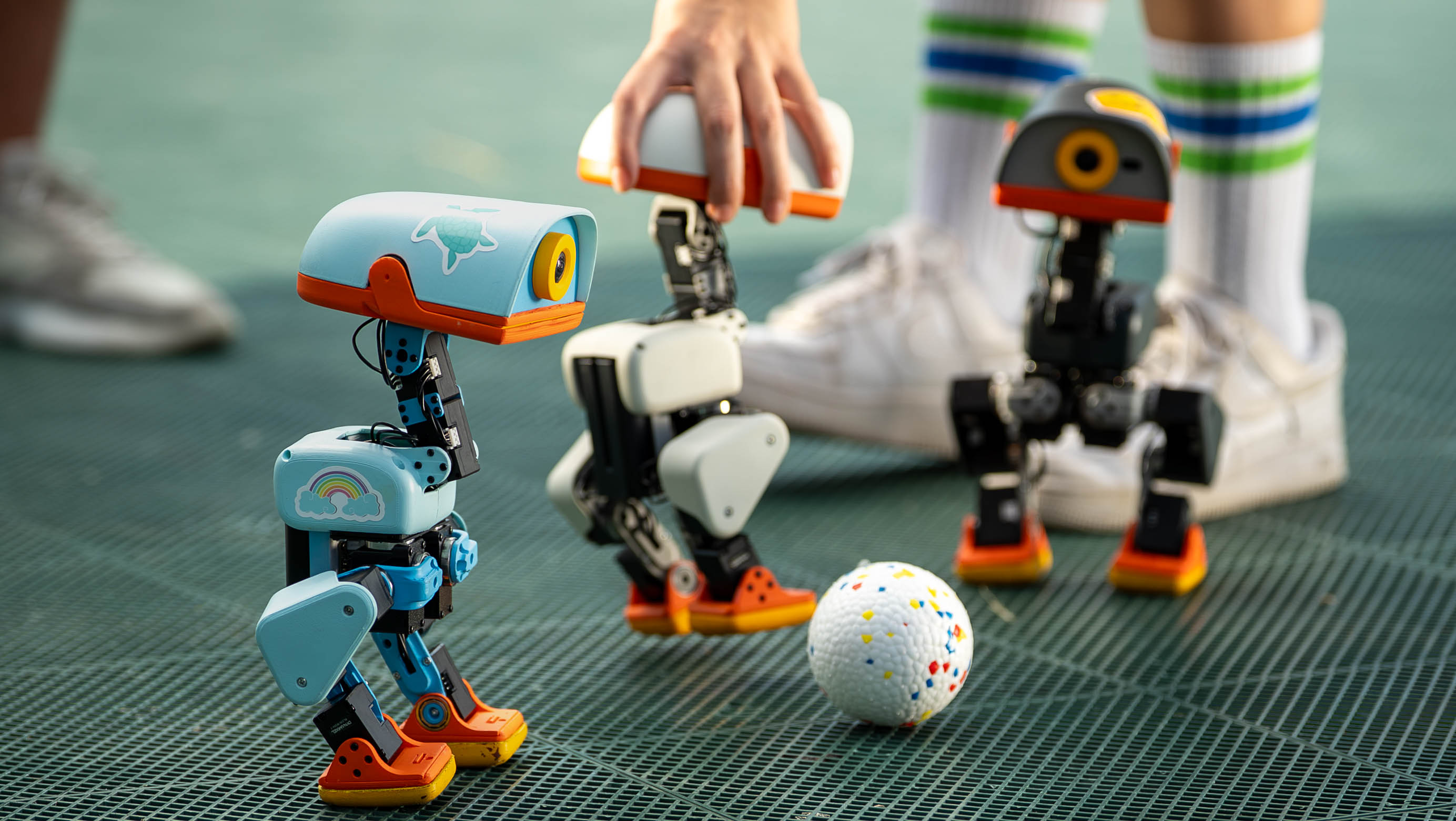
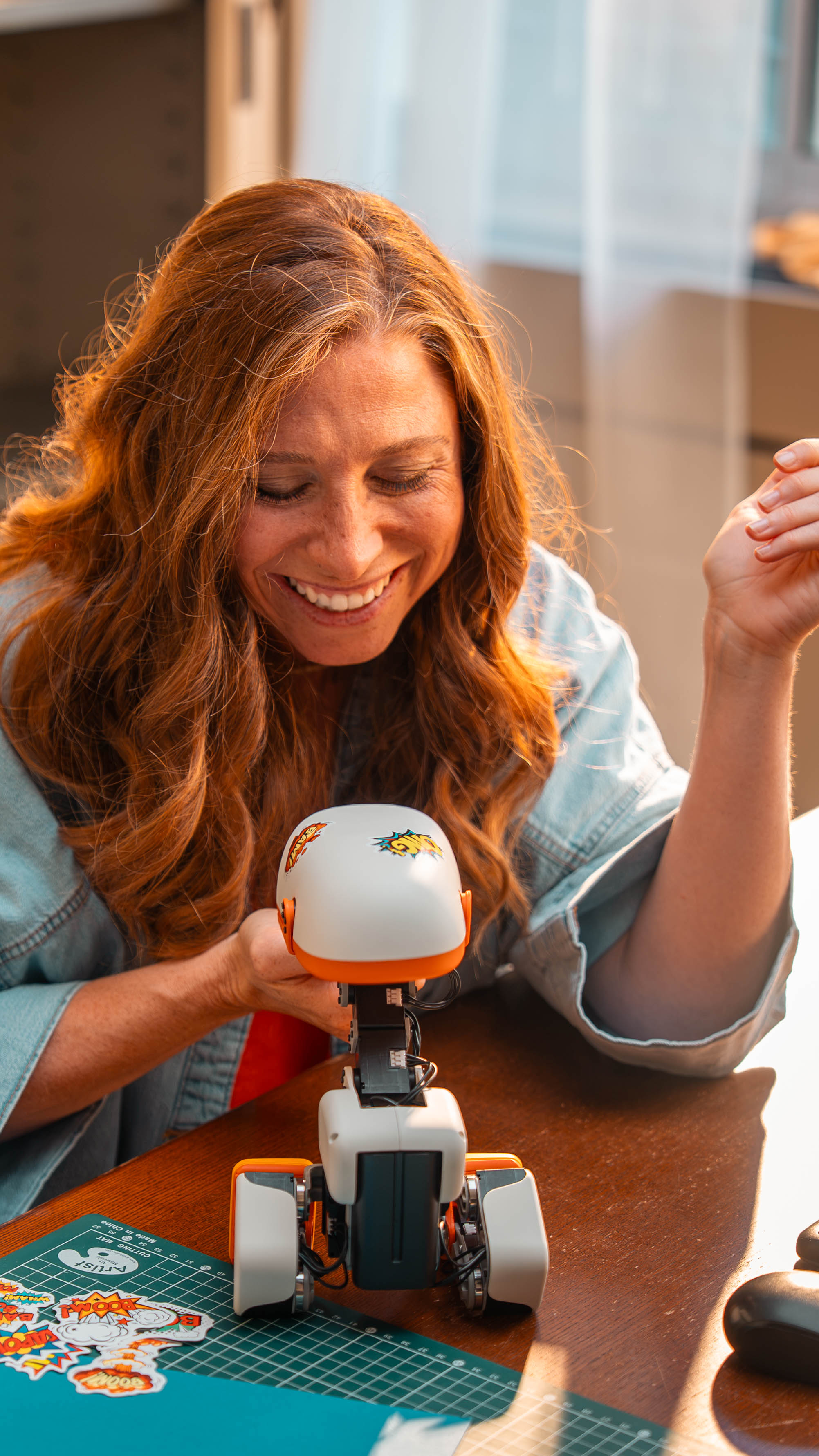
Microduck makes a surprisingly good invitation to learn robotics. Pollen Robotics describes a small, two-legged machine that arrives with learned behaviors and leaves room for its owner to build more. You can start by controlling its movement; the more ambitious project is to change how that movement works. For curious makers, students and developers, that creates an appealing path from playing with a robot to understanding one. Pollen Robotics
That path is the story behind the duck. A finished trick gives you something to watch. A trainable robot gives you a question to investigate: what would it take to make the next attempt better? Microduck makes that question feel approachable, without making the engineering behind it disappear.
Its timing is interesting, too. NVIDIA’s October 23, 2026 technical article uses Microduck to illustrate a workflow connecting AI agents, simulation and robot learning. The robot gives those otherwise abstract stages a recognisable subject: a little machine trying to stay upright and move through a course.
Related discoveries
Published products with matching topics or technologies.
A 25 cm programmable biped robot with learned movement, a grasping beak and open-source software for physical AI experiments. Available for pre-order, with first deliveries targeted before Christmas 2026.
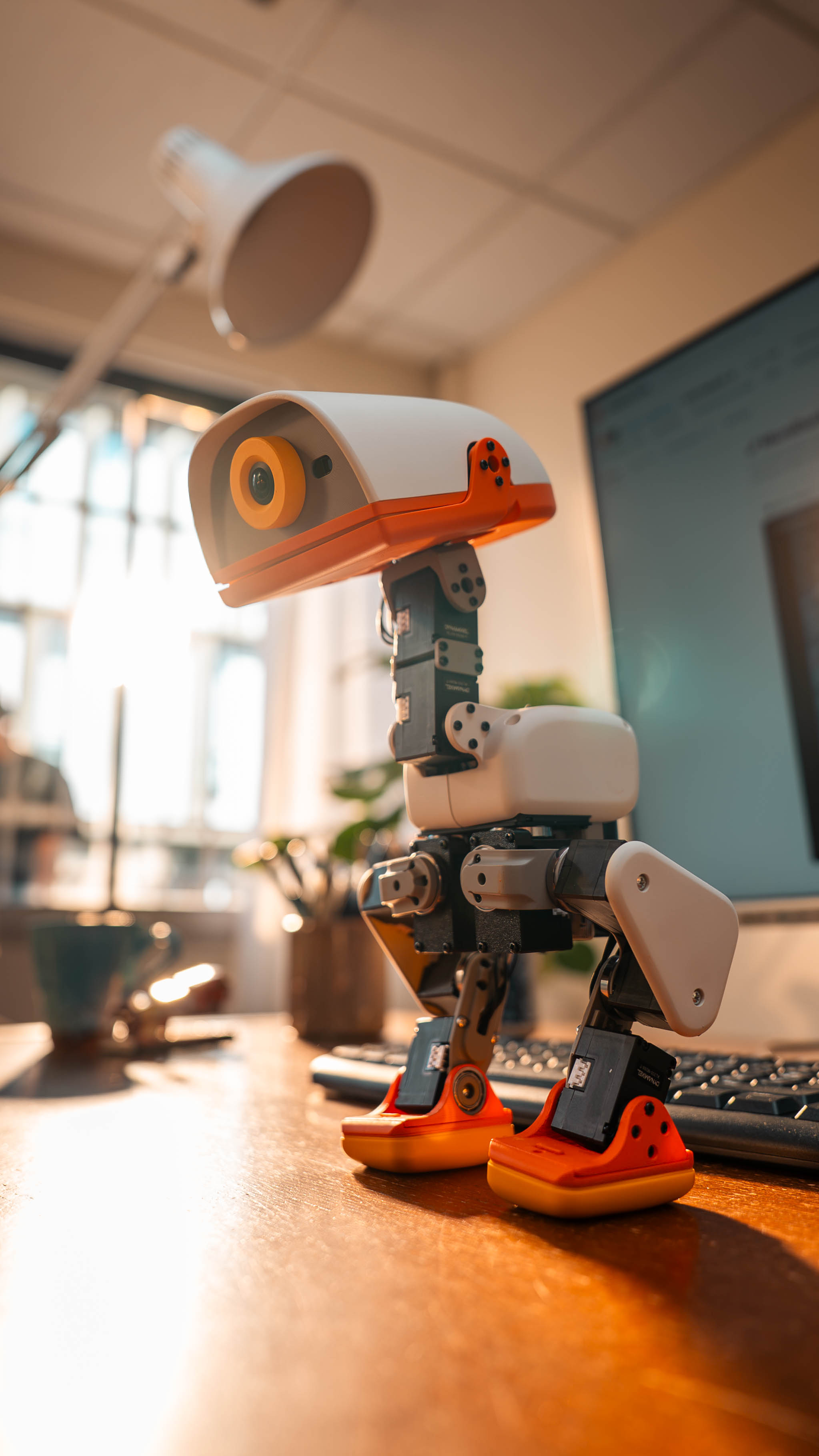
Pollen Robotics introduced Microduck on August 27, 2026. The company’s launch account places movement at the centre of the project: it wanted a small platform for experimenting with physical behavior, building on its earlier work with the interaction-focused Reachy Mini. Microduck’s beak and waddling proportions gave that ambition a character people could immediately recognise. Meet Microduck
There is a useful design idea here. An expressive little body can attract someone who has never opened a robotics repository. Once that person starts asking why it balances, how it recovers, or what makes one gait different from another, the character becomes an entry point to the mechanics.
That does not require imagining the robot as a person. The appeal can be simpler: it is easier to become interested in an engineering problem when you care about what the machine is trying to do.
Watch the duck, then look past the performance
The supplied GTC video provides a visual companion to the story. Watch it with a developer’s question in mind: which parts of a robot’s performance would you want to reproduce, and what evidence would establish that they work consistently?
A demonstration can make you curious. Evaluating a machine asks for something more specific: the task, the conditions, the control method and the frequency of success. Those are useful questions to carry from any short robot video into the documentation. They keep the spectacle connected to something a reader might actually learn, build or test.
The hardware gives the software a body
The maker’s press kit describes a robot about 25 centimetres tall, weighing under 800 grams, with 15 motors. It lists a front camera, a compact depth sensor, two inertial measurement units and an articulated grasping beak. The inertial sensors measure motion and orientation; the beak gives this armless robot a way to interact physically with objects. Microduck press kit
Those details help explain why the project is more interesting than a moving ornament. A developer can investigate the relationship between a body, its measurements and its commands. The body determines what movements are possible. Measurements provide information. A controller has to turn that information into useful action.
The distinction matters when reading an AI product description. A list of sensors establishes equipment, while a demonstrated task establishes something about behavior. Neither alone establishes that a robot can handle every situation in a room.
The press kit also makes a valuable qualification: the open-source claim applies to the software stack. Readers should not assume that all mechanical and electronic design files carry the same promise.
What a learned movement actually means
Microduck’s main software repository describes a runtime that drives its servos from neural policies, with a control loop running at 50 hertz. In everyday terms, that is 50 control cycles each second. The repository separates this onboard software from the project that trains the policies. Microduck robot software
A policy is the part that connects observations with actions. That definition is useful because it separates learning a behavior from executing one. Training produces a policy; the robot then runs the resulting model as part of its control system. Seeing a learned movement does not establish that the robot is retraining itself as you watch.
For a prospective owner, this changes the appeal. The project offers a route to inspect and modify the software behind movement, rather than leaving the behavior as an unexplained performance. You can ask where a command enters the system, which policy handles it and how the result reaches the motors.
That is a much more concrete starting point than simply being told a robot is intelligent.
Practice starts with a simulated duck
Pollen’s separate Microduck RL repository documents training environments built with mjlab and MuJoCo Warp, using a reinforcement learning method called PPO. Its task list includes walking, standing up, sitting, ground interaction and roller movement. Policies can be exported for the robot’s runtime. Microduck RL
This gives experimentation a structure. Choose a task, inspect how it is defined, train a candidate policy, then examine what it does. If you were investigating recovery after a fall, for example, you would want to understand the starting positions and what counts as a successful finish before interpreting a result.
The repository requires a CUDA GPU for local training and also documents a Hugging Face Jobs option. That is an important practical distinction: buying the robot and providing the resources for custom training are separate decisions.
It also helps put NVIDIA’s work in context. Microduck already has a documented training route. The new NVIDIA workflow adds another way to explore it; its particular workstation setup should not be treated as the definition of owning a Microduck.
Where AI agents enter the picture
In NVIDIA’s example, Hermes and Nemotron help plan an obstacle course, while Astra assists with assets and environment preparation. The workflow uses Isaac Sim for simulation and Isaac Lab for policy training. One ramp-and-obstacle adaptation run used 4,096 parallel environments on an RTX PRO 6000 Blackwell Workstation Edition GPU. NVIDIA’s Microduck workflow
The distinction between the agents and the movement policy is important. Planning a training scene and controlling a robot’s joints are different jobs. An agent can help prepare the experiment; a trained policy supplies the learned behavior being evaluated.
NVIDIA’s article covers preparation, training and evaluation, with detailed hardware deployment outside its scope. It also shows physical walking, but readers should distinguish that demonstration from proof that the complete simulated obstacle task has transferred to hardware.
Real motors complicate the lesson
A simulated motor needs to behave enough like its physical counterpart for training to be useful. Isaac Lab’s actuator documentation describes Better Actuator Models, or BAM, as a way to represent small servo behavior using parameters identified from bench measurements. The model includes effects such as command delay, friction and supply voltage falling under load. Isaac Lab actuator documentation
This is where the engineering becomes especially revealing. Asking for a joint position is only the beginning of a physical action. The mechanism must respond while carrying load and interacting with the rest of the body. A training environment that makes that response unrealistically convenient could teach the wrong lesson.
For someone learning robotics, the practical takeaway is to look beyond the appearance of the virtual robot. A convincing image and a useful motor model answer different questions. The important model is the one that captures the behavior the experiment depends on.
Why the training world needs variation
Isaac Lab’s transfer guidance describes domain randomization: varying relevant properties so that a policy does not become too dependent on one simulated setup. Its examples include friction, mass, actuator response and observation noise. The guidance also stresses plausible ranges rather than arbitrary extremes. Isaac Lab transfer guidance
The idea is easy to understand through a proposed experiment. If you wanted to investigate sensitivity to friction, changing friction deliberately would let you ask a more useful question than watching repeated success on one fixed surface. You would still need to define the range and evaluate the outcome.
Variation therefore belongs alongside measurement. Making a training world more varied is a method to investigate robustness; it is not a certificate that every real floor will work. That distinction keeps a promising training technique from becoming an unsupported product guarantee.
NVIDIA’s separate October 21 tutorial on Hugging Face documents an Isaac Lab route through training, evaluation, ONNX export and deployment to a configured physical Microduck. It specifies a supported Linux and NVIDIA GPU setup for training, and stresses consistency in observations and action scaling when transferring the model. Microduck sim-to-real tutorial
Those requirements are part of the story because they show what sits between an attractive demo and a reproducible project. The exported model has to fit the system that will run it. A successful training run is one milestone; a controlled hardware evaluation is another.
For a student or maker, that sequence creates useful stopping points. You can inspect a simulation before touching hardware, examine an exported model’s requirements, and compare the intended behavior with the eventual result. Each stage gives a different reason to trust—or revise—the experiment.
Walking is only one part of knowing the world
Pollen’s October 23 engineering posts offer another reason to look closely. Its odometry account explains how Microduck estimates movement using its feet and an inertial sensor. Odometry is an estimate of how the robot has moved, and the accompanying mapping work addresses how that estimate can drift. Microduck odometry
The mapping article describes combining leg odometry with an 8×8 depth sensor, running onboard. It also reports limitations: a narrow view can make different positions look similar, and measurements need checking against an external reference. The team describes building a measurement setup to examine those errors. Microduck mapping
This adds useful perspective to the duck’s capabilities. Moving, estimating position and building a map are related problems with different evidence behind them. A reader should be able to appreciate progress in each without assuming that progress in one solves all the others.
What to check before joining the flock
At the source check on October 24, 2026, Pollen’s store described Microduck as a pre-order and quoted US$399 before taxes and shipping. The storefront also displayed regional currency pricing, so buyers should confirm their market and checkout total. Its listed launch destinations include the US, Canada, the EU, the UK, Norway, Switzerland, Japan and South Korea. Official Microduck store
Pollen’s launch announcement targets first deliveries before Christmas 2026. That remains a delivery target rather than evidence that a particular order has shipped. The supplied microducks.org page identifies itself as a demo storefront, so use Pollen’s own product and store pages for purchasing information. Launch announcement · Demo-site disclosure
There are everyday considerations alongside the training tools. The store lists an included gamepad and a removable NP-F550 battery, with approximately one hour of battery life. Treat that runtime as a maker estimate, with the press kit explicitly noting that use affects duration. A classroom planning a session or a maker planning an afternoon of experiments would want to account for charging and spare-battery needs. Store specifications · Battery conditions
It is also worth deciding what you want from the first week. Using the supplied controls, inspecting the software and training a custom behavior are different levels of involvement. The documentation gives you a way to assess that commitment before placing an order, rather than treating every possible future project as an immediate feature.
The most useful first step is to explore the documented training project before deciding how far you want to take it. Microduck’s appeal is the connection between a playful machine and an inspectable learning process. Watch the duck move, then follow the trail back to the experiment that made the movement possible.
Source-based reporting; no hands-on testing. Sources checked October 24, 2026.